


Most drivers have seen the warning signs. The yellow triangles with a leaping stag silhouette posted at the edges of rural roads. Most drivers have also, in all honesty, stopped paying attention to them. They are everywhere. Nothing ever happens. And then one evening it does.
Up to 74,000 deer vehicle collisions are estimated to occur on UK roads every year. That figure comes from the British Deer Society, and it accounts for the significant number of incidents that are never reported. The ones that are reported result in 400 to 700 human injuries annually and approximately 20 human fatalities. The annual cost of vehicle repairs alone, separate from the human injury costs, exceeds £11 million.
This is not a niche problem. It is one of the most consistent and predictable road safety challenges in the UK, and it is one that has proved remarkably resistant to the conventional responses deployed against it for decades. Understanding why that is, and what is actually starting to work, matters for anyone responsible for road safety on routes where deer populations and vehicle traffic share the same landscape.
The Scale of Deer Vehicle Collision in the UK
The UK is home to six species of wild deer. Roe, red, fallow, sika, muntjac, and Chinese water deer all live alongside a road network that has expanded steadily into habitats those species have occupied for centuries. The result is one of the highest rates of deer vehicle collision per road kilometre in Europe.
In Hampshire alone, the local constabulary recorded 457 deer-related collisions in 2023. That is from a single county. Extrapolate that pattern across the South of England, where deer populations and traffic density are both high, and the national figure of up to 74,000 incidents annually becomes easier to understand. Southern England and the South East are identified as the highest-risk regions, with some stretches of A-road recording more than 75 collisions per five-kilometre section over a measured period.
In Europe the problem is even larger in absolute terms. Research estimates that more than 500,000 deer are killed on European roads every year. Germany alone records around 220,000 deer vehicle collisions annually. Denmark records approximately 100,000. Switzerland around 9,000. The UK sits within a continent-wide pattern that shows no meaningful sign of reducing without deliberate intervention.
What makes the UK figures particularly notable is the underreporting gap. Many deer vehicle collision incidents, particularly those involving smaller species like muntjac and roe deer where the vehicle damage is limited, are simply not reported to the police or recorded anywhere. The true scale of the problem is almost certainly larger than the data currently shows.
When and Where Deer Vehicle Collisions Happen
One of the most useful things known about deer vehicle collision in the UK is that it is not random. It clusters in time and location with a consistency that makes it, at least in principle, predictable and preventable.
There are two peak periods in the year. The October to December window corresponds with the rutting season for several deer species, when animals move more widely and more unpredictably than at any other time of year. The May peak is associated with young deer moving through territories as vegetation thins before the summer growth. Both periods see sharp increases in the number of animals crossing roads at speed and without the hesitation that characterises deer behaviour at quieter times.
Time of day is equally predictable. The highest-risk window runs from sunset to midnight, with a secondary peak in the early morning hours before dawn. Parliamentary research submitted to the UK road safety inquiry found that 53 percent of all animal-vehicle collisions resulting in human casualties occur at night. That compares to just 17 percent of other road hazard collisions occurring at night. Deer are crepuscular and nocturnal by habit. They are most active precisely when drivers have least visibility.
Location patterns are consistent year on year. Road sections that border woodland, pass through agricultural land with hedgerow cover, or cross established deer movement corridors produce repeated incidents. Research from the National Deer-Vehicle Collisions Project identified the same stretches of road appearing as hotspots across multiple years of data, which means the locations where investment in prevention would have the most impact are already largely known.
Why Warning Signs and Driver Education Have Not Been Enough
The standard response to deer vehicle collision risk in the UK has been roadside signage, public awareness campaigns, and occasional speed limit reductions in the highest-risk zones during peak season. All of these have a role. None of them has proved sufficient.
The problem with warning signs is a fundamental one about human attention. A driver travelling an A-road they use regularly has seen the deer warning signs hundreds of times. They have passed them without incident hundreds of times. The neurological effect of repeated exposure to a warning that does not produce consequences is well documented: the warning stops producing the heightened alertness it was designed to create. The sign is there. The driver does not really see it any more.
Driver education campaigns face a similar ceiling. Most drivers who are likely to encounter a deer vehicle collision situation already know, in theory, that deer cross roads at night in rural areas. Knowing something in the abstract and maintaining active vigilance for it on a familiar road at 10pm after a long day are different things. Education changes what people know. It does not reliably change what they notice in the moment.
Reflective roadside posts, acoustic deterrents triggered by vehicle headlights, and infrared fencing systems have all been trialled at various points, including a notable scheme in Exmoor National Park in 2017 using headlight-activated strobe lights and ultrasound. Results from these trials have been mixed. Where they work, they work on specific short sections of road. Scaling them across the many kilometres of high-risk route that exist across the UK is where the approach runs into practical and economic limits.

How AI Detection Is Changing the Approach to Deer Vehicle Collision Prevention
The limitation that all passive deterrence and driver-awareness approaches share is the same one: they cannot tell you a deer is about to cross the road right now. They can only influence behaviour in general terms, across all times and all situations, whether a deer is present or not. That is inherently inefficient, and it is why the collision rate has proved so resistant to reduction through these methods alone.
AI-based detection inverts that logic. Instead of asking drivers to be alert at all times on the off chance a deer appears, it monitors the road environment continuously and responds only when an animal is actually detected. The driver receives a warning in the moment when it is actionable, not as a general background instruction they have stopped processing.
Camera systems trained on wildlife detection can identify a deer entering the roadside zone, approaching the carriageway, or beginning to cross, and activate both a driver alert and a deterrence response within seconds. The deterrence component, which may include directed light and sound designed to make the road environment feel unsafe to the animal, addresses the problem from both ends simultaneously. The deer is discouraged from continuing onto the road. The driver is warned that an animal is ahead. Both things happen in real time, without human monitoring.
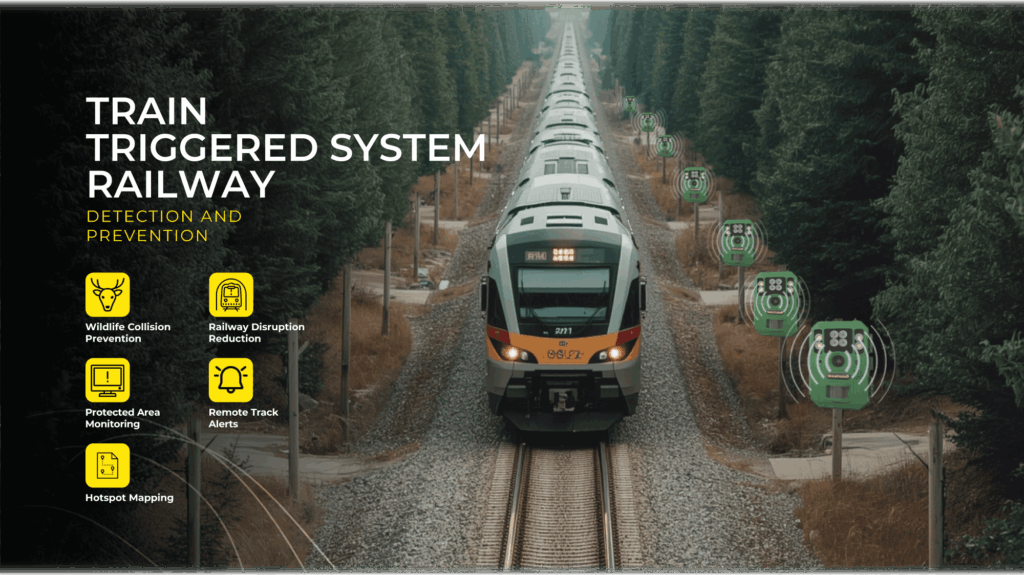
This is the core advantage of systems like the Animal Triggered System for transport corridors, which is designed precisely for high-risk sections of road and rail where animal crossing events are predictable in location but unpredictable in timing. The system does not need a human to be watching. It responds to what the cameras actually see, at the moment it sees it, every hour of every day including the high-risk window between sunset and midnight when staff are not routinely deployed.
What a Practical Deer Deterrence System on Roads Looks Like
A well-deployed road-based deer deterrence system is built around the risk profile of the specific route it protects. Not all high-risk sections of road carry identical risks. The most effective deployments focus on locations where the combination of deer population density, road speed, limited visibility, and historical incident data creates the clearest case for intervention.
For highway operators and local authorities managing A-roads through known deer habitat, a camera-based detection system placed at intervals on the highest-risk sections can provide meaningful protection at a fraction of the cost of a single serious accident involving human casualties. The economic case for prevention is strong. Parliamentary evidence submitted on this topic calculated the economic value of preventing the human injury accidents associated with deer vehicle collision at more than £30 million per year across Britain as a whole.
For individual landowners or estate managers whose property borders high-speed roads and who are aware of regular deer crossing activity on their boundary, the same detection and deterrence principles can be applied at a property scale. The Innovation Factory wildlife deterrence range includes options appropriate for both highway-scale deployment and smaller-scale property applications.
If you manage road safety on a route with a documented deer vehicle collision history, or if you are responsible for land that borders a high-risk road section, a conversation about what a site-specific detection system could offer is a practical starting point. The data on where these collisions happen is already there. The question is whether the right tools are in place to act on it.
The Broader Responsibility Around Deer Vehicle Collision
Deer populations in the UK are at their highest recorded levels. There are estimated to be over two million wild deer in Britain, a number that has grown significantly over the past several decades as natural predators remain absent and habitat has in some areas improved. That growth in population, set against an expanding road network, means the underlying conditions that produce deer vehicle collisions are not getting better on their own.
The British Deer Society continues to document and map deer vehicle collision hotspots across the UK, making the case that the problem can be reduced if the right combination of data, awareness, and physical intervention is applied in the right places. Their work shows that the locations where most collisions happen are not mysterious. They are known. What has been missing is reliable, cost-effective technology capable of monitoring those locations continuously and responding in real time.
That technology now exists. And the case for deploying it on the stretches of UK road where deer vehicle collision is a documented, recurring, and entirely predictable problem has never been stronger.
Twenty human fatalities per year from deer vehicle collisions in the UK is not an acceptable baseline. It is a problem with known locations, known timing, and now known solutions. The decision to act on that is what changes the number.
Innovation Factory develops AI-powered wildlife detection and deterrence systems for roads, railways, agriculture, and property protection. Explore the full wildlife deterrence solutions range or get in touch to discuss road safety requirements on your route or site.