

Most road safety campaigns focus on speed, seatbelts, and drunk driving. Very few talk about the animal standing in the middle of a desert highway at 2 in the morning, invisible until it is too late.
Camels are not small animals. A fully grown Arabian camel can weigh up to 726 kilograms. When a vehicle travelling at 120 kilometres per hour hits one, the camel’s body does not slide off the bonnet the way a smaller animal might. Its legs collapse, its body comes through the windscreen, and the occupants of the vehicle absorb the full weight. The results are almost always catastrophic.
Camel vehicle collision is a documented public safety crisis across Saudi Arabia, the UAE, Oman, and other Gulf states. It is also one that receives far less attention than it deserves, and far less investment in practical solutions than the death toll warrants. That is beginning to change.
The Scale of the Problem Most People Do Not Know About
More than 600 camel-related road accidents are recorded every year in Saudi Arabia alone. Research published on this problem estimates the fatality rate for a camel vehicle collision at approximately 0.25 deaths per incident. That makes it roughly six times deadlier than the average road accident in the country.
In the UAE, the camel population has grown from around 100,000 to over 250,000 in the past four decades. In Saudi Arabia, more than half a million camels move freely across landscapes that now include major highways cutting through what was once open desert. The roads came to the camels. The camels did not come to the roads.
The problem is not limited to the Gulf. Parts of North Africa and Australia face similar challenges with free-roaming camel populations crossing active transport routes. In every case, the pattern is the same. The accidents happen at night, at speed, with little or no warning for the driver.
Why Camels Are So Dangerous on Roads
Understanding why camel vehicle collisions are so lethal requires understanding what makes camels uniquely difficult to detect and avoid.
Camels are tall animals with dark coats. At night, vehicle headlights tend to catch the legs first, at a height and distance that can look like road markings or debris. By the time the driver processes what they are seeing, the gap has closed. There is often no time to brake.
Camels also behave unpredictably around vehicles. Research from Australia found that camels sometimes run alongside moving vehicles rather than away from them. In desert environments where roads are straight and drivers travel at high speeds for long distances, a camel that moves onto the carriageway provides almost no reaction time.
And unlike deer or other common road animals, camels are culturally significant in many of the regions where collisions are most frequent. Culling is not an option. Removal is complicated. Fining owners when animals stray has had limited effect. The solution has to be detection and deterrence, not elimination.
Why Traditional Solutions Have Not Worked
The response to camel vehicle collision risk has historically relied on three approaches. Warning signs on highways tell drivers that camels may be present. Roadside fencing attempts to keep camels off the carriageway. And fines are issued to owners whose animals stray onto roads.
Academic research has assessed all three of these approaches and found significant limitations across the board. Warning signs require drivers to maintain sustained alertness over long, monotonous stretches of road where nothing happens for hours at a time. Human attention does not work that way reliably.
Fencing is expensive to install across thousands of kilometres of highway, difficult to maintain in harsh desert conditions, and creates new problems when it channels camels toward unfenced crossing points where collisions concentrate rather than reduce.
Owner fines assume that ownership can be established after an accident, that fines are large enough to change behaviour, and that the animals can be reliably controlled. In practice none of these conditions holds consistently across the affected regions.

How AI Detection Is Changing the Response to Camel Vehicle Collision Risk
The shift happening now is from passive warning to active detection. Instead of relying on a driver to notice a sign, stay alert, and spot a camel in time, AI-powered systems take the detection task out of human hands entirely.
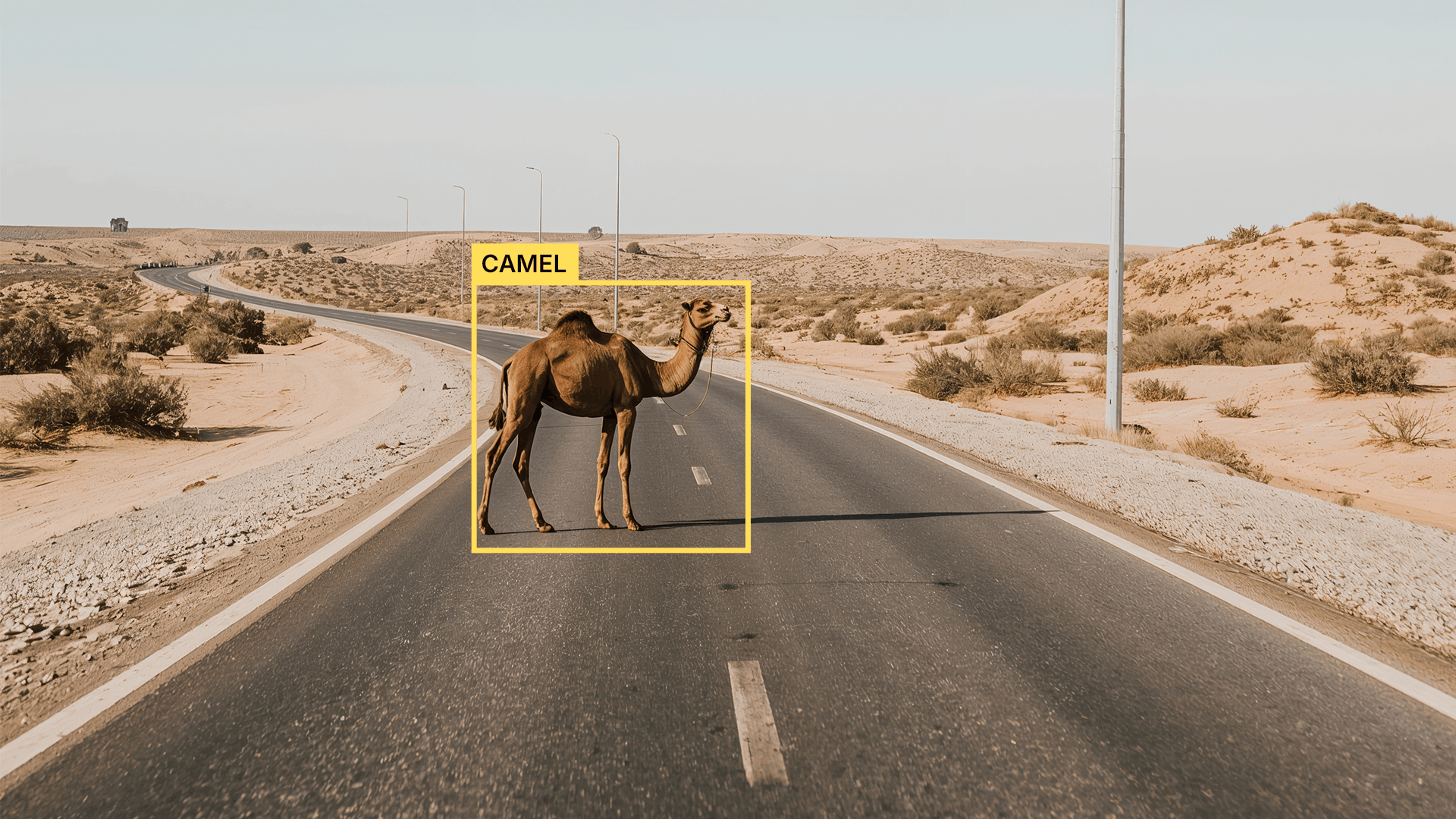
Camera-based detection systems placed at regular intervals along high-risk road sections can identify a camel approaching or entering the carriageway and trigger an immediate response. That response might be a flashing warning to drivers through roadside LED systems, an alert sent to a control centre, a deterrence sound or light directed at the animal, or all three simultaneously.
The key distinction between these systems and what came before is speed and consistency. A camera running AI analysis does not get tired on a long night shift. It does not miss something because it was looking the other way. It processes every frame, every second, regardless of conditions. When a camel vehicle collision event begins to develop, the system responds in the time it takes a human to blink.
Research published by scientists working on this problem has shown that deep learning object detectors can identify camels on roads with high accuracy even in low light conditions. The technology exists. The challenge has been deploying it in a form that works in real-world highway environments rather than controlled research settings.
What a Practical Camel Deterrence System on Roads Actually Does
A properly configured road-based deterrence system does two things at the same time. It deters the animal from staying on or crossing the road, and it warns drivers that an animal is present ahead.
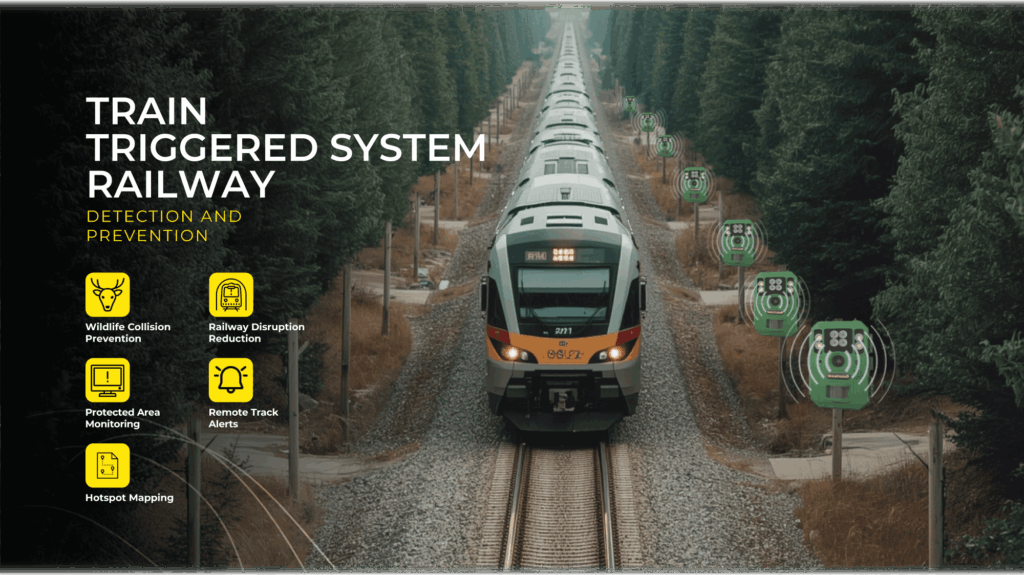
On the deterrence side, systems like the Animal Triggered System for transport corridors use AI-trained cameras to identify approaching animals and activate a combination of flashing lights and sound frequencies that make the road environment feel unsafe to the animal. The goal is not to harm the camel but to discourage it from crossing into the path of traffic. In most cases, animals that encounter these deterrents turn back before reaching the carriageway.
On the driver warning side, the same detection event that triggers the deterrence response can simultaneously activate roadside warning systems that give drivers several seconds of advance notice. At highway speeds, a few seconds of warning is the difference between a reaction that works and one that comes too late.
The Innovation Factory wildlife deterrence range is designed with exactly these dual requirements in mind, providing both animal-facing deterrence and integrated driver alert capability for deployment on highways, rail corridors, and other high-risk transport routes. If you are responsible for road safety in an area with known camel crossing activity, a conversation about site-specific deployment is the right starting point.
The Broader Argument for Taking This Seriously
Camel vehicle collision is not an edge case problem. It is a predictable, recurring event on specific road sections at specific times of year. That predictability is actually an advantage when it comes to prevention, because it means detection and deterrence systems can be deployed where they will have the most impact rather than spread thinly across entire highway networks.
The World Health Organisation estimates that road traffic injuries cost most countries between 3 and 5 percent of their gross domestic product annually. Animal-vehicle collisions form a measurable part of that figure in affected regions. The economic case for investment in prevention is strong, and the human case is stronger.
What has been missing until recently is technology that can be deployed practically and affordably in the environments where these collisions occur. Desert highways are not like urban roads. Power infrastructure is limited. Maintenance access is infrequent. Systems have to be robust, low-maintenance, and capable of operating in extreme temperatures day and night.
The camel vehicle collision problem is solvable. The technology is ready. What it requires now is the decision to deploy it.
Innovation Factory designs and deploys AI-powered wildlife deterrence systems for roads, railways, farms, and property protection. Explore the full wildlife deterrence solutions range or get in touch to discuss your road safety requirements.