


Imagine waking up at 3 in the morning to something heavy moving through your maize field. By the time you grab a torch and get outside, half an acre is already gone. It happens in minutes. The loss can take a full season to recover from, if you recover at all.
Elephant crop damage is one of the most underreported agricultural crises in the world. And yet the people most affected, smallholder farmers in rural communities, often have no meaningful protection. They are left choosing between defending their crops at personal risk or absorbing losses they simply cannot afford.
This guide covers what actually causes these incidents, why most common responses do not work reliably, and what farmers who have reduced their losses are actually doing differently.
Why Elephants Target Farmland in the First Place
It is worth understanding the behaviour before jumping to solutions, because most failed deterrence methods fail precisely because they ignore it.
Elephants are intelligent, seasonal, and highly adaptable. As their natural habitats shrink due to deforestation and expanding human settlements, they are forced to move through landscapes that did not exist a generation ago. Farmland, sitting in what was once forest or grassland, becomes a natural corridor. And with that comes the temptation of easy, high-calorie crops.
Maize, sugarcane, bananas, and rice are particular favourites. Nutritionally, cultivated crops are often far richer than what elephants find in degraded forests. Once a herd discovers that a farm is a reliable food source, they return. They remember routes for years.
According to the World Wildlife Fund, human-elephant conflict is one of the most critical conservation and community safety challenges across Africa and Asia today. The problem is not aggression. It is hunger, habit, and shrinking space. That distinction matters enormously when you are choosing how to respond.
The Real Cost of Elephant Crop Damage to Farming Communities
The scale is staggering. Studies across India’s forest-border states have documented crop losses running into hundreds of thousands of dollars per district every year. In parts of Kenya and Cameroon, some farming families lose 30 to 60 percent of their annual harvest in a single season due to elephant crop damage alone.
Beyond the immediate financial damage, there is the psychological toll. Farmers guard their fields at night, sometimes for weeks at a stretch, with little more than noise-makers and fire. It is exhausting, it is dangerous, and in rare but tragic cases it is fatal. Human-elephant conflict results in hundreds of human deaths and thousands of elephant deaths every year.
What is striking is how little support most affected farmers actually receive. Insurance schemes exist in some countries but rarely cover full losses. Government compensation programmes are often slow and under-resourced. Farmers are largely on their own.
Traditional Methods: An Honest Assessment
Let us be straightforward about what does not work reliably, because plenty of guidance online glosses over this.
Noise-based deterrents like drums, firecrackers, and shouting have limited lasting effect. Elephants habituate to these quickly. What startles a herd on the first night barely registers by the third. They learn.
Chilli-based barriers including chilli rope fences and smoke have shown some genuine promise in research settings, particularly in parts of Africa. But they require constant maintenance, are weather-dependent, and need replacing regularly. As a standalone solution they are inconsistent at best.
Standard electric fencing is effective in theory but expensive to install and prone to outages. Elephants have also been known to learn how to break them. They require continuous upkeep that most smallholder farmers cannot reliably provide.
Trenches are physically demanding to dig and maintain, ineffective against smaller herds that simply walk around them, and impossible to scale across large farms.
None of these are useless. But none of them are reliable enough on their own to fully prevent elephant crop damage. Most farmers end up cycling through them, spending money and energy with diminishing returns each time.
What Farmers in High-Risk Zones Are Actually Doing Now
The most effective outcomes consistently combine two things: early warning and targeted deterrence.
The logic is simple. If you know an elephant is approaching your field while it is still 500 metres away, you have time to respond with targeted noise, light, or other deterrents before the animal reaches the crops. Once it is inside the field, your options narrow dramatically.
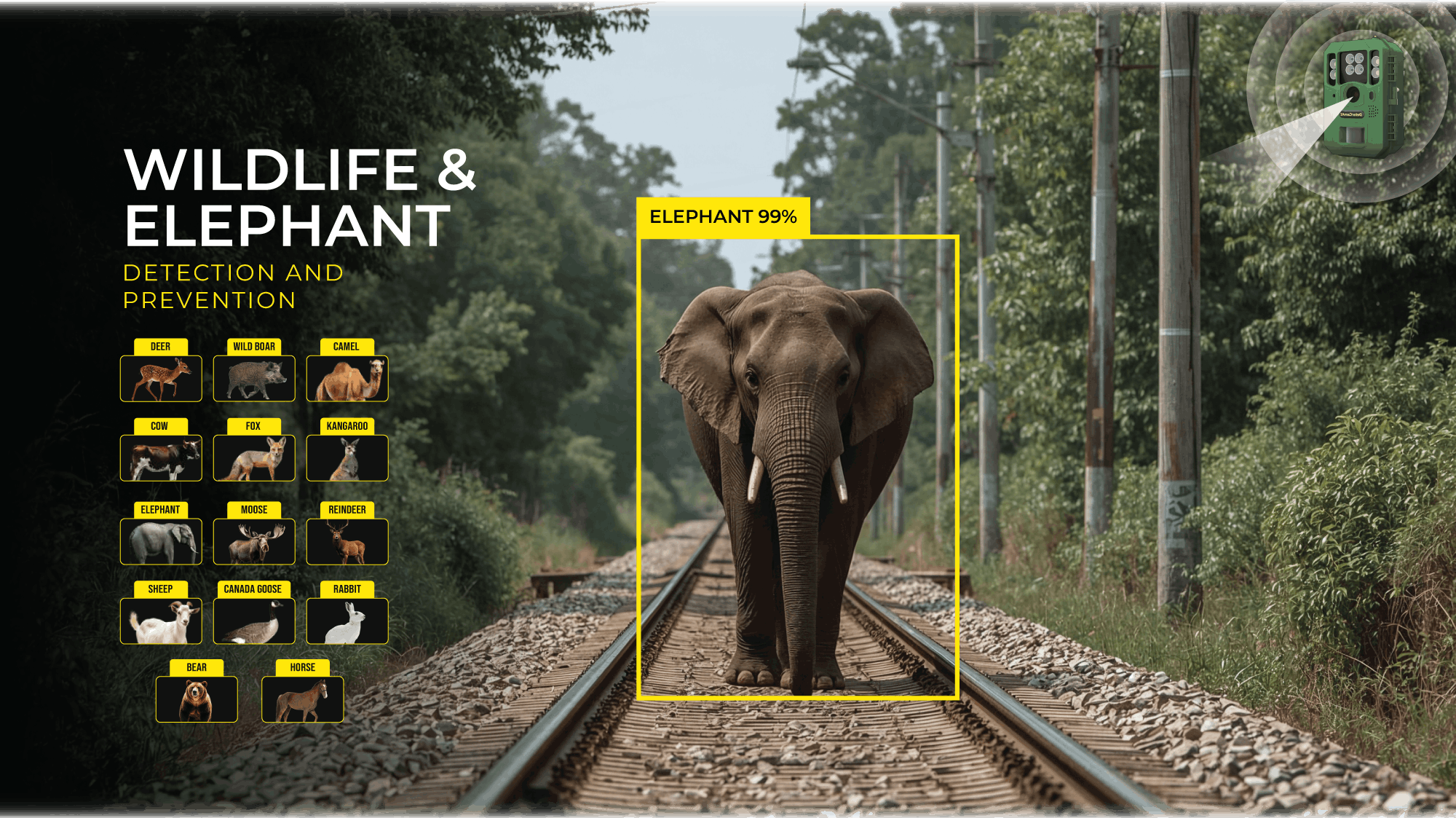
That is where AI-powered wildlife detection is genuinely changing things for farms dealing with elephant crop damage on a regular basis.
Systems like the Animal Triggered System (ATS) for property and agriculture use AI-trained cameras to detect large animals at the perimeter, day or night, and trigger deterrence responses automatically. This is not a passive sensor. It actively identifies species, distinguishes elephants from livestock or people, and activates a deterrence response within seconds. Farmers receive an alert on their phone. They do not have to be watching.
For farms with larger perimeters or remote fields, the Crop Protection System extends coverage across wider areas and is designed specifically for agricultural environments where manual monitoring is not practical.
The result is a shift from reactive guarding, which means sleepless nights and physical risk, to proactive automated protection that works even when you are not there.
Practical Steps You Can Take Right Now
Whether you are looking at a technology upgrade or working with a limited budget, here is a practical framework to start with.
Map your exposure first. Which crops and which fields are most at risk? Where do elephants historically enter from? Focus your resources on high-risk entry points rather than trying to cover everything equally. Spreading resources too thin never works.
Talk to your neighbours. Elephant movement is rarely isolated to a single farm. A coordinated response across several properties is far more effective than individual farms acting alone. In many areas, community-level deterrence schemes have dramatically reduced losses compared to neighbours going it alone.
Document every incident. Dates, times, entry points, size of herd, extent of damage. This data matters for insurance claims, for government support applications, and increasingly for AI training data that helps detection systems improve over time. A simple log book is enough to start.
Think about alert systems before physical barriers. Knowing an animal is approaching gives you options. Physical barriers alone, without early warning, often delay contact rather than prevent it. The sequence matters.
Reduce attractants where you can. Certain crops carry higher risk. Timing your planting cycles to avoid peak elephant movement periods, or adjusting what you grow in the most exposed fields, can reduce incidents without requiring significant investment. The IUCN guidelines on human-elephant conflict offer useful regional context on movement patterns worth reading.
Coexistence Is the Only Long-Term Answer
Elephants are not the enemy here. They are responding to a landscape that has been dramatically altered by human expansion. Culling programmes have been tried. Relocation is expensive, logistically complex, and not always successful. The animals come back.
The only path that works over time is genuine coexistence. Protecting farms effectively enough that farmers do not need to see elephants as threats, while ensuring elephants can move through landscapes without ending up in conflict situations that get them killed.
If elephant crop damage is affecting your land, it is worth looking at what a properly configured detection and deterrence system can offer. The Elephant Deterrence System from Innovation Factory is built specifically for this challenge. It is humane, automated, and designed for real-world agricultural conditions rather than controlled research environments.
Protecting your crops should not mean risking your safety. And it should not mean giving up.
Innovation Factory builds AI-powered wildlife deterrence systems for agriculture, railways, highways, and property protection. Explore the full range of wildlife deterrence solutions or get in touch to talk through your situation.