

Is Trespassing a Crime? Understanding the Law in the UK
Walking across a field, taking a shortcut through private land, or stepping onto railway lines might seem harmless, but where does the law stand on these actions? The question of whether trespassing is a crime is more complex than a simple yes or no. The answer often depends on where you are, what you are doing, and the impact of your presence.
This article will explore the legal landscape surrounding trespassing in the UK. We will clarify when it’s a civil matter versus a criminal offence, examine specific scenarios like trespassing on railway lines, and discuss the severe consequences it can have. We will also look at how modern technology is helping to prevent dangerous and costly trespass incidents.
Trespassing: A Civil or Criminal Matter?
In most everyday situations in England and Wales, simple trespassing is a civil wrong, not a criminal offence. This means if you wander onto someone’s land without permission, the landowner can ask you to leave. If you refuse, they can use reasonable force to remove you or sue you for damages in a civil court. However, you generally won’t face a police record or prison time for a simple, unintentional stroll.
The landowner’s primary legal recourse is to seek an injunction to prevent you from trespassing again or to claim compensation if your presence caused damage. For example, if you damage crops or break a fence while on their property, you would be liable for the cost of repairs.
When Does Trespassing Become a Criminal Offence?
While basic trespass is a civil issue, the situation changes significantly under specific circumstances. The question, “Is trespassing a criminal offence?” has a clear answer: yes, it can be. Several laws turn what would be a civil trespass into a criminal act.
Aggravated Trespass
The Criminal Justice and Public Order Act 1994 introduced the concept of aggravated trespass. This law makes it a criminal offence to trespass on land and intentionally obstruct, disrupt, or intimidate others from carrying out lawful activities. This could include disrupting a legal hunt, blocking the entrance to a factory, or preventing construction work. A conviction for aggravated trespass can lead to fines and even imprisonment.
Trespassing in Protected Sites
Certain locations are given special protection by law. Trespassing on these sites is a criminal offence due to national security, public safety, or operational importance. These include:
- Military bases and defense sites.
- Royal palaces and residences.
- Designated sites crucial to national infrastructure, such as power stations.
Entering these areas without permission can result in immediate arrest and serious legal penalties.
Trespass with a Firearm
It is a serious criminal offence to enter or be on any land or in any building as a trespasser while in possession of a firearm or imitation firearm, without a reasonable excuse. This law is designed to prevent poaching and other criminal activities involving weapons.
Is Trespassing Illegal in the UK? The Case of Railway Lines
One of the most dangerous and legally clear cut forms of criminal trespass involves the railway network. The answer to “is trespassing illegal UK” is an emphatic yes when it comes to railways. Under the British Transport Commission Act 1949 and other railway-specific byelaws, trespassing on the railway is a criminal offence.
Why is the law so strict? The dangers are immense. Active railway lines are live environments 24/7, with fast-moving trains that can appear silently and quickly. The third rail, which powers many trains, carries a lethal electrical current. The risks are not only to the trespasser but also to passengers and rail staff. An emergency brake application to avoid a person on the tracks can cause injuries to those on board.
The consequences of railway trespass extend far beyond the immediate danger. Each incident causes significant disruption across the network, leading to a cascade of delays and cancellations.
The Staggering Cost of Railway Trespass
The impact of trespass on the UK rail network is enormous. It is not just a minor inconvenience; it is a key source of disruption that generates both primary and reactionary delays, affecting thousands of passengers and critical freight services daily.
Consider these key statistics:
- Financial Cost: Trespass incidents cost the rail industry an estimated £55 million per year in delay-related penalties and operational recovery.
- Freight Delays: The freight sector alone suffers losses exceeding £30 million annually due to disruptions caused by people on the line.
- Incident Frequency: There are approximately 13,500 trespass incidents recorded each year, an average of over 35 per day.
- Daily Impact: These incidents affect more than 400 trains every single day, causing widespread travel misery for commuters and leisure travelers alike.
Each time a person is spotted on or near the tracks, all trains in the vicinity must be stopped or slowed down until the situation is resolved. This creates a ripple effect, delaying subsequent services and causing severe network congestion that can take hours to clear.
Preventing Trespass: The Role of Technology
Given the high stakes, preventing railway trespass is a top priority for network operators and law enforcement. Traditional methods like fencing and warning signs are essential but often insufficient, especially in remote or vast areas. This is where innovation and technology are making a critical difference.
Advanced solutions are now being deployed to create a more proactive and effective deterrent. One of the most promising developments is the use of AI-powered detection systems.
A Modern Solution: AI-Powered Trespass Detection
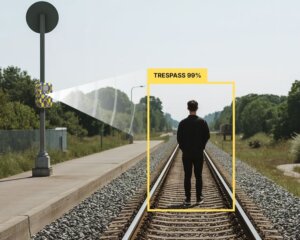
We have developed an intelligent fusion sensor designed specifically to capture trespass events in real-time, even in the most challenging and remote locations. This system addresses the limitations of traditional security by providing immediate, accurate, and actionable alerts.
Here’s how it works:
- Trio Sensor Fusion: The system uses a combination of three different sensors. This trio-sensor approach ensures an accuracy rate of over 99%, drastically reducing false alarms that can be triggered by wildlife or weather conditions.
- Night and Low-Light Capability: The sensors are engineered to perform flawlessly in complete darkness and adverse weather, ensuring 24/7 protection. Trespass incidents often occur at night, and this technology ensures they do not go undetected.
- Automated Instant Alerts: When a trespass event is detected and verified, the system automatically sends instant alerts. These can be text messages or phone calls directed to key personnel at Network Rail and the British Transport Police, enabling a rapid response.
- AI Context-Aware Alarms: The system is powered by a dynamic, context aware AI algorithm. This intelligence allows the system to trigger a mix of powerful audible and visual alarms at the trespass location. These on-site alarms act as a powerful deterrent, often causing the trespasser to leave the area immediately, and alert anyone nearby to the danger.
By providing early warnings and enabling a swift response, this technology helps prevent incidents before they escalate. It protects lives, reduces costly delays, and ensures the smooth operation of vital railway services. This proactive approach is a significant step forward from simply reacting to incidents after they have already caused major disruption.
The Legal and Moral Responsibility
Ultimately, the law treats trespassing with varying degrees of seriousness depending on the context. A simple mistake might lead to a civil dispute, but intentional disruption or entering dangerous areas like railway lines is a criminal matter with severe consequences.
So, is trespassing a crime? Yes, it frequently is, and for good reason. Laws against trespass on critical infrastructure exist to protect individuals from harm and to prevent the massive societal and economic disruption that follows.
Understanding and respecting these laws is everyone’s responsibility. For operators of critical infrastructure like the railways, deploying advanced solutions like AI-powered detection is not just an operational improvement it’s a vital measure to safeguard lives and maintain the services we all rely on. By combining public awareness with cutting-edge technology, we can work towards a safer and more efficient network for everyone.