


In February 2025, a passenger train travelling near a wildlife reserve in Sri Lanka struck a herd of elephants crossing the tracks before dawn. Six elephants were killed. The train derailed. Remarkably, no passengers were seriously hurt. But the derailment made international headlines and raised a question that railway operators across Asia, Europe, and North America are increasingly being forced to answer: why does this keep happening, and what is being done about it?
Wildlife train collision is not a new problem. It is an old problem that has never been properly solved. Animals have been dying on railway tracks since railways were first built. What has changed is the scale of awareness, the quality of data now being collected, and the technology available to act on it.
This article looks at why wildlife train collisions keep occurring, which species and regions are most affected, why conventional responses have consistently fallen short, and how AI-powered detection is starting to deliver results where other approaches have not.
The Global Scale of Wildlife Train Collisions
The numbers are sobering. Over the past 30 years, train collisions have killed more than 220 elephants in India alone. That figure does not include the thousands of additional animals killed every year across species and regions that rarely make the news. Deer, bears, antelope, wolves, and smaller mammals all die on railway tracks at a scale that is only beginning to be properly documented.
In one eleven-day period in Saskatchewan, Canada, four separate wildlife train collisions killed more than 100 pronghorn antelope. Research conducted across Banff and Yoho National Parks in Canada recorded 646 animal strikes reported by a single railway operator over a 24-year period. These are not anomalies. They are consistent, predictable patterns occurring in specific locations at specific times.
The International Union of Railways publishes annual railway safety data. Their 2024 report tracked 6,063 documented deer encounters across 20 participating rail networks in a five-year period. The ratio of wildlife events per train-kilometre has been slowly declining as mitigation efforts improve, but the absolute number of significant railway accidents rose from 1,660 in 2020 to 2,018 in 2024.
Sri Lanka offers a particularly sharp example. Nine elephants were killed by trains in 2024. Twenty-four were killed in 2023. The fluctuation shows that conditions change year to year, partly based on habitat pressure and seasonal movement, and that no single measure has permanently solved the problem.
Why Railways Are So Dangerous for Wildlife
Understanding why wildlife train collision events are so frequent requires understanding what railways look like from an animal’s perspective.
Railway tracks cut directly through habitats. Forests, grasslands, wetlands, and wildlife corridors that evolved over thousands of years are bisected by linear infrastructure that animals have no evolutionary experience navigating. The tracks themselves can attract animals because they provide flat, easy passage through dense terrain. Gravel ballast retains heat and can attract reptiles. Spilled grain from freight trains draws rodents, which in turn attract predators. Railways are not neutral to wildlife. They are actively part of the landscape animals move through.
Trains compound the danger in ways that roads do not. A car can brake from highway speed to a stop in a few seconds. A freight train travelling at 100 kilometres per hour can take more than a kilometre to stop after emergency braking is applied. By the time a driver sees an animal on the tracks, there is often nothing that can be done. The outcome is determined by whether the animal moves, not whether the train does.
Night operations make this worse. Many species are most active at dawn and dusk, precisely the low-visibility windows when trains are still running at full speed. The Sri Lanka collision that derailed a passenger train in February 2025 happened before dawn. That timing is not unusual. It is the norm for the most serious incidents on record.
Why Existing Solutions Have Not Been Enough
Railway operators have tried various approaches to reduce wildlife train collision events. Speed reductions in known high-risk zones during seasonal migration periods have shown measurable results in some regions. Fencing to guide animals away from tracks has had success on specific corridors, particularly in parts of Europe. Dedicated wildlife crossings built beneath or over railway lines are a longer-term infrastructure investment that works well where implemented.
The limitation in every case is scale. The world’s railway networks span hundreds of thousands of kilometres. Fencing every metre of track that passes through wildlife habitat is not economically viable. Speed reductions across entire networks have serious implications for timetables and freight efficiency. Wildlife crossings require significant capital investment and planning timelines measured in years.
The result is a patchwork of measures that work in specific locations but leave the majority of high-risk track unprotected. Research into railway wildlife mortality has consistently identified the same core gap: there is no reliable, cost-effective way to know in real time that an animal is on or near the tracks, and to act on that information before a collision occurs.
That is the gap that AI-based detection is now beginning to fill. As researchers at the University of Alberta noted in their long-running study of railway wildlife mortality, the path forward requires being more surgical in applying the right kind of mitigation at the right locations. Real-time detection is what makes that possible.

How AI Detection Is Changing the Response to Wildlife Train Collision Risk
The core shift that AI brings to this problem is the ability to monitor continuously at low cost across long stretches of track. A human patrol walking a railway line can cover a few kilometres in an hour. A network of AI-equipped cameras can monitor the same line 24 hours a day, every day, in any weather condition, and flag an animal presence within seconds of detection.
Modern wildlife train collision prevention systems use trained machine learning models to distinguish between animals and other objects that regularly appear near tracks. A deer crossing the line looks different from a falling branch. A herd of elephants approaching the track from a forest edge looks different from a maintenance crew. The system makes that distinction in real time and responds accordingly.
When an animal is detected, the system can do two things simultaneously. It can send an alert to the train driver and operations centre, giving them seconds of advance notice that would not otherwise exist. And it can activate deterrence measures directed at the animal, using light and sound to make the track environment feel unsafe and encourage the animal to move away from the line before the train arrives.
That two-stage response is what separates modern AI-based systems from older passive approaches. Warning the driver is useful. Deterring the animal before it reaches the track is better. Doing both at the same time is how wildlife train collision rates are actually reduced rather than just managed after the fact.
What a Railway Wildlife Deterrence System Looks Like in Practice
A properly deployed railway wildlife deterrence system is built around the specific risk profile of the route it protects. Not every section of track carries the same risk. The most dangerous locations tend to be where railway lines cross established wildlife movement corridors, where vegetation provides cover close to the track, and where previous incidents have already been recorded.
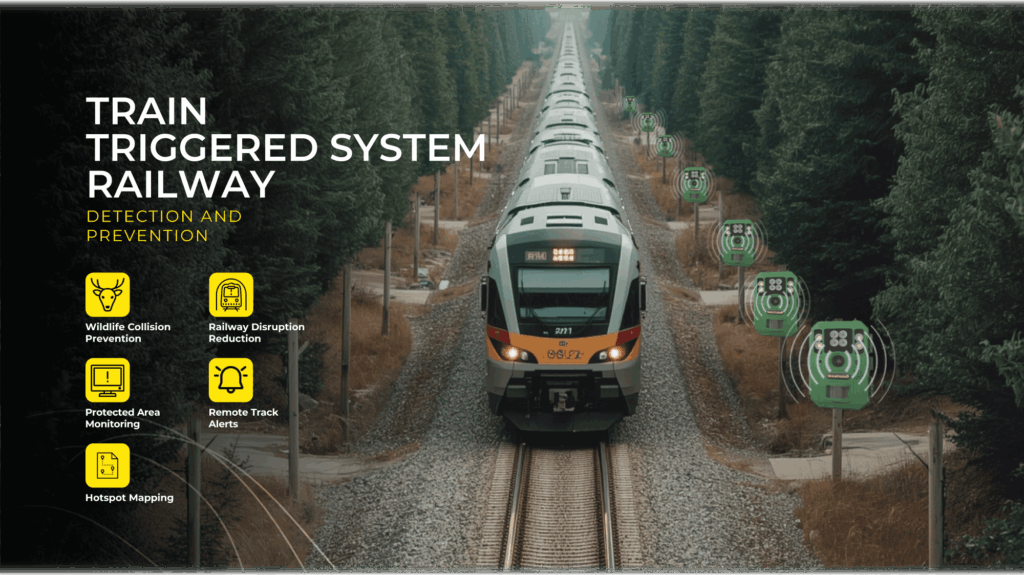
Systems like the Animal Triggered System for Railways are designed with these operational realities in mind. Trackside AI cameras monitor defined detection zones along the line and are calibrated to the species most likely to be encountered on that specific route. When an animal enters the detection zone, the system activates deterrence responses and simultaneously communicates with train operations. The entire process from detection to response takes seconds.
For routes where train drivers need advance warning integrated directly into their cab systems, the Train Triggered System provides a connected layer of in-cab alerting that gives drivers actionable information in real time rather than relying on trackside signage or manual reporting.
Both systems are designed to operate without continuous human monitoring, to function in low light and adverse weather, and to be deployed incrementally on high-risk sections of existing infrastructure without requiring major engineering works. If you manage or advise on railway safety and animal strike risk is a documented issue on your network, talking through a site-specific approach is the right starting point.
The Case for Treating This as an Infrastructure Priority
Wildlife train collision events are not random bad luck. They are predictable events that happen in predictable places at predictable times of year. That predictability is not a reason to be resigned to them. It is a reason to act precisely and effectively.
The conservation argument is clear. Species that are already under pressure from habitat loss, climate change, and human encroachment cannot absorb additional mortality from railway strikes as a routine cost of living near infrastructure. In Sri Lanka, where elephant populations are already critically stressed, losing even nine animals in a single year to train strikes is a conservation problem as well as a safety one.
The operational argument is equally clear. A derailment caused by a large animal strike can put passengers at risk, damage rolling stock, and close a line for hours or days. The Sri Lanka incident in February 2025 derailed a passenger train. The cost of a single derailment, in disruption, repair, and liability, dwarfs the cost of installing detection systems on the sections of track where the risk is highest.
According to reporting by EcoWatch on global railway wildlife mortality, the challenge has always been less about whether solutions exist and more about whether operators treat the problem as one worth solving systematically. The technology is available. The data on where and when collisions occur is improving. What changes outcomes is the decision to deploy.
Innovation Factory develops AI-powered wildlife detection and deterrence systems for railways, highways, agriculture, and property protection. Explore the full wildlife deterrence solutions range or get in touch to discuss your railway safety requirements.